Group of Large Trees with Dense Green Foliage: Selecting the Right Forest Vector Assets
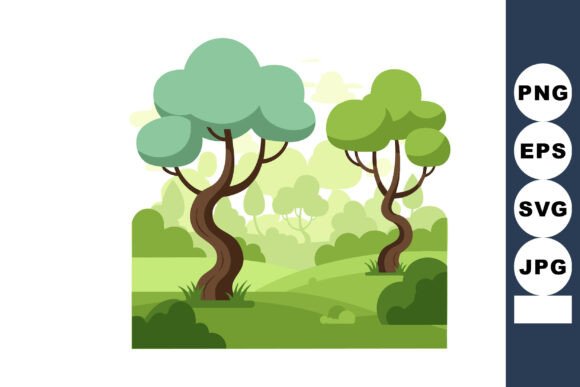
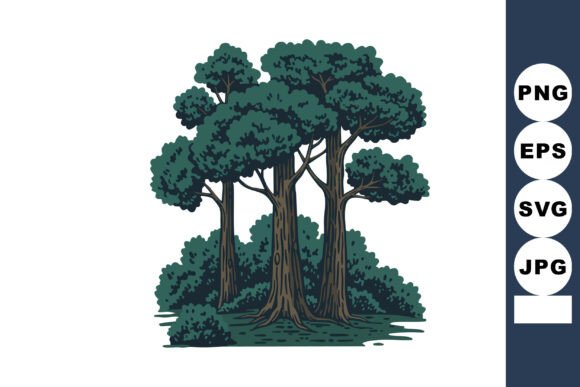
When designing nature-themed projects, finding a high-quality illustration that conveys tranquility without looking artificial is a common challenge. The Group of Large Trees with Dense Green Foliage asset addresses this specific need by providing a cohesive, peaceful forest scene suitable for various digital and print applications. This vector illustration features large trees with lush canopies and accompanying bushes, creating a natural depth that flat icons often lack. For designers, marketers, and educators, this type of asset serves as more than just decoration; it establishes an organic mood that supports environmental messaging, wellness branding, or educational content about ecosystems.
Interest in this specific style of illustration usually stems from a desire for versatility. Because the downloadable ZIP includes SVG, EPS, JPG, and PNG files, users can adapt the artwork for anything from a small web icon to a large-format banner. However, having multiple file formats does not automatically guarantee a successful design outcome. Many creators overlook technical nuances when integrating dense foliage vectors into their workflows, leading to pixelation, color mismatches, or licensing issues. Understanding how to properly evaluate and utilize these files ensures your final project maintains the professional polish intended by the original artist.
Common Pitfalls When Choosing Forest Illustrations
One of the most frequent mistakes occurs during the selection phase, where buyers focus solely on the thumbnail preview rather than the actual file structure. A thumbnail might look vibrant and detailed, but it does not reveal how the vector paths are constructed. In illustrations depicting a Group of Large Trees with Dense Green Foliage, complexity is expected. However, poorly optimized vectors can contain thousands of unnecessary anchor points. If you import such a file into web design software or embroidery digitizing programs, it can cause significant lag or rendering errors. Always inspect the vector geometry before committing to an asset if performance is a concern.
Another overlooked detail involves color mode compatibility. Forest scenes rely heavily on green gradients and subtle shading to create the illusion of density. If you purchase a vector pack intended for screen use (RGB) but attempt to print it on merchandise or brochures without conversion, the greens may appear muddy or neon. Conversely, using a CMYK-optimized file for a website can result in dull, lifeless colors. Before downloading, verify whether the included EPS or SVG files are color-managed for your specific output medium. Professional assets often include separate versions for print and digital, or at least provide clear documentation on color profiles.
Misunderstanding File Format Utility
While the inclusion of SVG, EPS, JPG, and PNG formats offers flexibility, misunderstanding their distinct purposes leads to inefficient workflows. A common error is using a rasterized PNG for a logo or scalable graphic simply because it has a transparent background. While convenient, PNGs have fixed resolutions. Scaling them up for a trade show banner will inevitably result in blurriness. The SVG or EPS files are designed precisely for this scalability. Reserve the JPG and PNG versions for mockups, social media posts, or non-critical web elements where file size matters more than infinite resolution.
Similarly, some users assume all SVG files are web-ready. Vectors depicting dense foliage can be surprisingly heavy in file size due to the sheer number of paths required to render individual leaves and branches. Using an unoptimized 2MB SVG as a background element on a landing page will negatively impact load times and SEO scores. It is better practice to use the provided JPG or PNG for web backgrounds and reserve the SVG for interactive elements or hero images where crispness at any zoom level is essential. If you must use the SVG online, run it through a dedicated optimization tool to strip metadata and simplify paths without sacrificing visual quality.
Evaluating Quality and Usability Before Download
To avoid post-purchase frustration, adopt a checklist approach when evaluating nature vectors. Instead of reacting emotionally to the aesthetic, assess the technical viability of the Group of Large Trees with Dense Green Foliage illustration against your project requirements. Consider the following practical checks:
- Layer Organization: Are the trees, bushes, and background elements separated into logical layers or groups? Merged layers make it nearly impossible to change the color of just the foliage or remove the ground shadow without redrawing the entire asset.
- Style Consistency: Does the line weight and shading technique match your existing brand assets? Mixing hyper-realistic vector trees with flat, minimalist typography can create visual dissonance that confuses viewers.
- Editability: Test a sample file if possible. Can you easily adjust the hue/saturation? Are the gradients applied as editable fills or expanded into hundreds of tiny shapes? Expanded gradients are notoriously difficult to recolor.
- Licensing Clarity: Verify if the license covers your intended use case. Some "free" or low-cost assets restrict commercial use or require attribution, which may not be feasible for client work or product packaging.
Neglecting these evaluations often results in wasted budget. You might buy a beautiful forest scene only to discover later that the layers are flattened, making it useless for the seasonal color variations your client requested. Or, you might find the license prohibits use in NFT projects or template resale. Spending five minutes reading the technical specs and license terms saves hours of redesign work and potential legal headaches.
Avoiding Visual Clichés and Composition Errors
Beyond technical specifications, there is a creative risk in using generic nature assets. Dense green foliage is a popular trope, and using it without thoughtful integration can make a design feel like stock clip art. To elevate the Group of Large Trees with Dense Green Foliage illustration, consider how it interacts with your layout. Avoid placing the trees as a mere backdrop with text slapped directly over the busiest areas. This reduces readability and diminishes the artwork's impact.
Instead, use the negative space within the composition effectively. Good forest illustrations are designed with "breathing room" between branches specifically for headline placement. If the asset feels too crowded, do not hesitate to crop or mask parts of the vector. Since you have access to scalable formats, you can zoom in on a specific cluster of trees to create a unique texture or border, rather than always using the full scene. This customization transforms a standard download into a bespoke design element.
Practical Advice for Seamless Integration
For those new to working with complex vector nature scenes, start by establishing a consistent color palette before importing the asset. Extract key colors from the illustration and add them to your document’s swatch library. This ensures that any additional elements you draw—such as buttons, borders, or secondary icons—harmonize with the forest scene rather than clashing with it. If the greens in the vector are too saturated for your brand, apply a global adjustment layer or edit the vector fills directly to mute the tones. It is far better to modify a high-quality asset to fit your brand than to settle for a mediocre asset that happens to match your colors perfectly.
Finally, maintain organized file hygiene. When you extract the ZIP containing the SVG, EPS, JPG, and PNG files, rename them descriptively rather than keeping generic filenames like "vector_trees_01.svg." Create a dedicated asset folder for your project and store the source files separately from exported derivatives. This simple habit prevents version control issues and ensures that if you need to return to the original vector months later for a revision, you can locate the correct high-resolution master file immediately. Treating digital assets with the same organizational rigor as physical inventory significantly improves long-term efficiency and project satisfaction.