Woman Standing Outside Simple House Line: Visual Storytelling for Modern Design
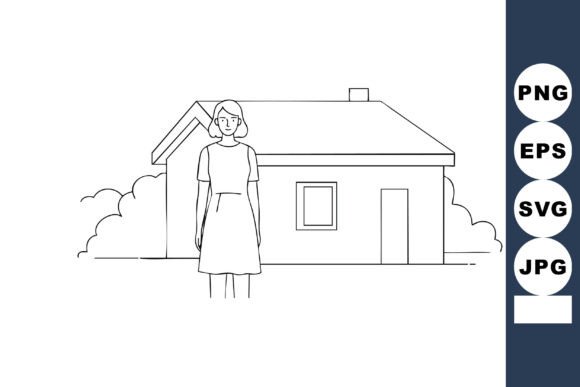
The Woman Standing Outside Simple House Line illustration captures a specific moment of tranquility that resonates across multiple design disciplines. Depicting a female figure positioned before a minimalist architectural outline with subtle background foliage, this vector asset communicates stability, domestic peace, and approachability without relying on complex details or photorealism. For designers, marketers, and content creators, this image serves as more than just decoration; it is a functional visual shorthand for concepts related to home, safety, personal space, and lifestyle balance. The clean line art style ensures it integrates seamlessly into modern interfaces, print materials, and branding kits where clarity and emotional connection are paramount.
Real Estate and Property Technology Applications
In the competitive real estate market, visuals often dictate the first impression of a listing or service. The Woman Standing Outside Simple House Line offers a versatile alternative to generic stock photography for property tech platforms, mortgage lenders, and housing agencies. Unlike photographs that can feel dated or overly specific to a certain demographic, this line illustration maintains a timeless quality that appeals to a broad audience aged 20 to 50.
- Mortgage and Lending Portals: Use the illustration on landing pages discussing "first-time homebuyer" programs. The calm demeanor of the figure reduces the anxiety often associated with financial applications, suggesting a smooth transition to homeownership rather than bureaucratic stress.
- Vacancy and Rental Listings: For apartment complexes or rental management software, this graphic works effectively as a placeholder image or header for neighborhood guides. It signals a welcoming community atmosphere without promising specific amenities that might not exist in every unit.
- Home Insurance Marketing: Insurance providers frequently need to convey protection and peace of mind. The simple house line combined with the serene figure creates an immediate association with safety and coverage, making it ideal for policy explanation documents or quote request forms.
The inclusion of bushes in the background adds a necessary layer of organic softness to the geometric structure of the house. This detail is crucial for real estate contexts because it implies established landscaping and care, subtly suggesting that the property is well-maintained and livable.
Enhancing Wellness and Lifestyle Branding
Beyond physical structures, the concept of "home" extends to mental health, self-care, and work-life balance. Creative professionals in the wellness sector find significant value in the Woman Standing Outside Simple House Line because it visually anchors abstract concepts of inner peace to a tangible setting. The illustration’s lack of facial features allows viewers to project themselves into the scene, making it highly effective for inclusive marketing.
Consider a telehealth platform focusing on family therapy or postpartum support. Using this illustration in app interfaces or email newsletters reinforces the idea of a safe, private space for healing. Similarly, lifestyle bloggers and influencers discussing minimalism, decluttering, or slow living can use this graphic as a featured image for articles about creating sanctuary at home. The line art style aligns perfectly with the aesthetic of mindfulness brands that prioritize whitespace and simplicity over visual noise.
For interior designers and home stagers, this asset serves as an excellent icon for portfolio websites or client welcome packets. It represents the human element of design—reminding clients that spaces are ultimately created for people to inhabit peacefully. When paired with earthy color palettes or muted pastels, the illustration enhances brand identity systems focused on sustainability, eco-friendly living, or biophilic design principles.
Technical Versatility Across File Formats
The practical utility of this resource lies heavily in its downloadable ZIP package containing SVG, EPS, JPG, and PNG files. Understanding when to deploy each format is essential for maintaining professional quality across different media. Many users download assets but fail to leverage the specific strengths of each file type, resulting in pixelated prints or bloated web pages.
Vector Formats for Scalability and Customization
The SVG and EPS files are the workhorses of this collection. Because they are mathematically defined paths rather than pixel grids, they can be scaled from a business card size to a billboard without losing crispness. More importantly, these formats allow for direct editing in software like Adobe Illustrator, Affinity Designer, or even free tools like Inkscape.
If your brand guidelines require a specific shade of teal instead of the default black line, the SVG file lets you change the stroke color in seconds. You can also adjust the line weight to match your typography or separate the woman, house, and bushes onto different layers for animation purposes. This editability makes the Woman Standing Outside Simple House Line a foundational asset rather than a static clip-art piece. Web developers should prioritize the SVG format for responsive websites, as it renders sharply on high-DPI mobile screens while keeping file sizes minimal for faster load times.
Raster Formats for Immediate Implementation
The PNG and JPG files serve scenarios where vector compatibility isn't available or necessary. The PNG version typically includes transparency, making it perfect for overlaying onto colored backgrounds, presentation slides, or social media graphics without awkward white boxes. This is particularly useful for non-designers using tools like Canva or PowerPoint who need a quick, professional-looking visual element.
The JPG format provides a solid background option optimized for photographic compositions or legacy systems that don't support transparency. While less flexible than vectors, having these raster versions ready saves time when you need to drop an image into a document or email signature immediately. However, users should always verify the resolution before printing; while suitable for digital use, raster files may require upscaling or replacement with the EPS version for high-quality offset printing.
Strategic Considerations Before Implementation
While the Woman Standing Outside Simple House Line is broadly applicable, thoughtful integration ensures it enhances rather than distracts from your message. Context matters significantly when using line art. Because the style is inherently minimal, it pairs best with clean layouts and ample negative space. Placing this illustration against a busy photograph or cluttered pattern will diminish its impact and reduce legibility.
Audience representation is another key consideration. Although the gender-neutral nature of the silhouette promotes inclusivity, some projects may require more specific representation. If your target demographic is exclusively male or non-binary, evaluate whether this specific figure aligns with your user personas. Conversely, if representing diverse family structures is important, consider pairing this illustration with complementary assets showing different household compositions to create a more comprehensive visual narrative.
Cultural connotations of housing imagery should also be reviewed. The "simple house" depicted here generally reads as suburban or rural Western architecture. For global campaigns targeting urban apartments or non-Western housing typologies, test whether this specific architectural line resonates with local audiences or if it inadvertently signals exclusion. Sometimes, removing the house element entirely and retaining only the figure and foliage can universalize the message while preserving the emotional tone.
Maximizing Emotional Resonance in Digital Spaces
In an era of information overload, the calm atmosphere conveyed by this illustration acts as a visual palate cleanser. User experience research consistently shows that appropriate whitespace and soothing imagery reduce cognitive load and increase engagement. When used in onboarding flows for smart home devices or property management apps, the Woman Standing Outside Simple House Line can decrease perceived complexity and build trust during critical first interactions.
Content strategists should view this asset as part of a larger visual vocabulary. Rather than using it once and discarding it, incorporate it into a consistent design system. Use variations of the same line weight and style across icons, headers, and dividers to create cohesive brand recognition. The bushes and house elements can be extracted and reused independently as bullet points or section markers, extending the value of the single download far beyond its initial composition.
Ultimately, the strength of this illustration lies in its ability to communicate complex emotions through simple means. Whether signaling safety for insurance customers, tranquility for wellness seekers, or possibility for prospective homeowners, the Woman Standing Outside Simple House Line provides a reliable, editable, and emotionally intelligent solution for contemporary visual communication challenges. By understanding both its technical specifications and its psychological impact, creatives can transform a basic line drawing into a powerful storytelling device that connects authentically with adult audiences navigating life’s domestic and personal milestones.